Half-Baked and Honest: The Case for Leaving Your Creative Work Incomplete
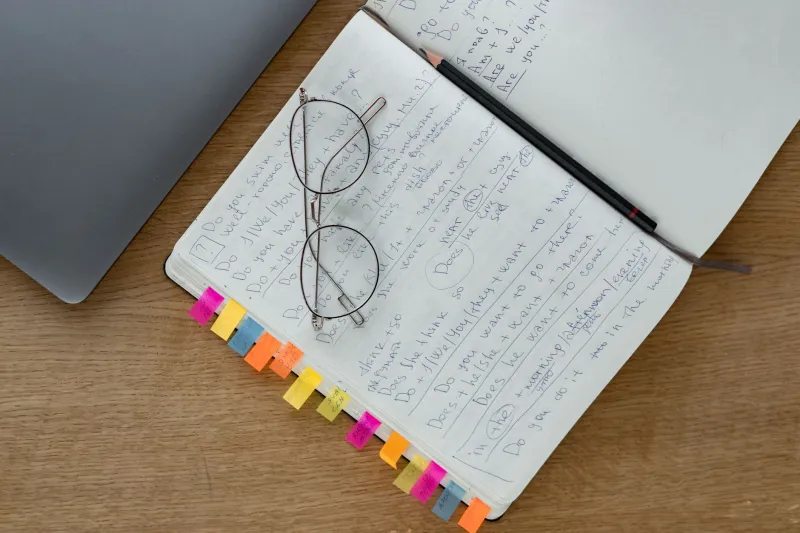
There's a notebook sitting on my kitchen table right now with about forty pages filled in and the rest completely blank. Some pages have full paragraphs. Some have a single sentence and then a long, trailing dash. One page is just the word eventually written in the top corner, underlined twice, like I was about to say something important and then got distracted by life.
For a long time, that notebook embarrassed me. It felt like evidence of something — laziness, maybe, or a lack of follow-through. But lately I've been thinking about it differently. Maybe that notebook, exactly as it is, is the most honest creative document I've ever made.
The Myth of the Finished Thing
We've been trained to think of completion as the goal. Finish the painting. Publish the essay. Release the album. The cultural narrative around creative work is almost entirely about the endpoint — the launch, the debut, the reveal. We celebrate finished things. We frame them, sell them, stream them.
But here's what that story leaves out: most of the actual making happens in the messy middle. The drafts nobody sees. The half-built ideas that got abandoned in favor of something else. The creative detours that went nowhere and taught you everything.
Perfectionism, for all its ambition, is actually pretty cowardly. It keeps you circling the work instead of releasing it — or worse, it keeps you from starting at all. The pursuit of a flawless finished product can become a reason to never let anything out into the world, which means the work just... sits there, suffocating under the weight of your own standards.
What Gets Lost in the Polish
Think about the artists and musicians you love most. Not the ones with pristine, overproduced records, but the ones whose work feels like it was made by an actual human being. The scratch in the vocal. The visible brushstroke. The paragraph that runs a little long because the writer clearly couldn't stop themselves.
Neil Young has talked openly about preferring rough takes. Kurt Vonnegut's manuscripts were famously messy. Jean-Michel Basquiat left drips and crossed-out words in his paintings on purpose — the corrections were part of the statement. These weren't accidents. They were choices to let the evidence of process remain visible.
There's something deeply relatable about work that still shows its seams. It says: a person made this. And in a world increasingly saturated with content that's been smoothed and optimized and A/B tested into submission, that humanness is actually pretty rare.
The Psychology of Why We Can't Let Go
So why is it so hard to leave things unfinished? Part of it is ego — we want to be seen as competent, together, capable of seeing things through. Releasing something incomplete feels vulnerable in a way that a polished product doesn't.
But there's also something deeper going on. Psychologists have long noted what's called the Zeigarnik effect: our brains tend to fixate on incomplete tasks more than completed ones. Unfinished things nag at us. They feel like loose threads we're supposed to tie up.
The problem is that in creative work, that nagging feeling can masquerade as perfectionism. We tell ourselves we're not done yet, that it needs more work, that it's not ready — when really, we're just scared of what happens after we let go.
Finishing something means it can be judged. Unfinished, it's still protected by its own potential.
Finding Freedom in the Incomplete
Here's a reframe worth sitting with: what if incompleteness isn't failure? What if it's a different kind of success?
Some of the most compelling creative work exists in a state of deliberate openness. Schubert's Unfinished Symphony is one of the most performed pieces in classical music — and it literally only has two movements. The poet Emily Dickinson published almost nothing in her lifetime; the thousands of poems found in her desk after she died were often unpolished, with multiple alternate word choices still written in the margins. We didn't lose anything by getting access to those drafts. We gained something.
There's a concept in Japanese aesthetics called ma — the idea that negative space, the pause, the gap, is itself meaningful. Not everything needs to be filled in. Sometimes the space between what you intended and what you actually made is where the most interesting thing lives.
Practical Ways to Make Peace with the Unfinished
If you're someone who hoards half-finished projects in folders you never open, here are a few ways to start thinking about them differently:
Share the process, not just the product. Post the work-in-progress. Show the sketch before the final painting. Let people into the middle of the thing. You might be surprised how much more connection you get from the unpolished version.
Set a "good enough" threshold. Not everything needs your maximum effort. Some things just need to exist. Give yourself permission to finish something at 80% and call it done.
Name the unfinished things. Instead of treating incomplete projects like failures, treat them like artifacts. They're records of where your head was at a particular moment. That has value, even if the project never goes anywhere.
Let some things just be experiments. Not every creative endeavor needs to become a finished piece. Some things are just for practicing. Some are just for you. That's allowed.
The Drift Is the Point
There's a reason this site is called Drift & Detail. Life doesn't resolve neatly. Neither does creative work. The things we make are reflections of who we are in a specific moment — and we're always changing, always mid-thought, always somewhere between where we started and wherever we're going.
That notebook on my kitchen table? I've stopped being embarrassed by it. It's a record of thinking in progress. Some of those half-sentences might turn into something someday. Most of them probably won't. And both of those outcomes are fine.
The work doesn't need to be done to matter. Sometimes the most honest thing you can make is the thing that shows exactly where you stopped.