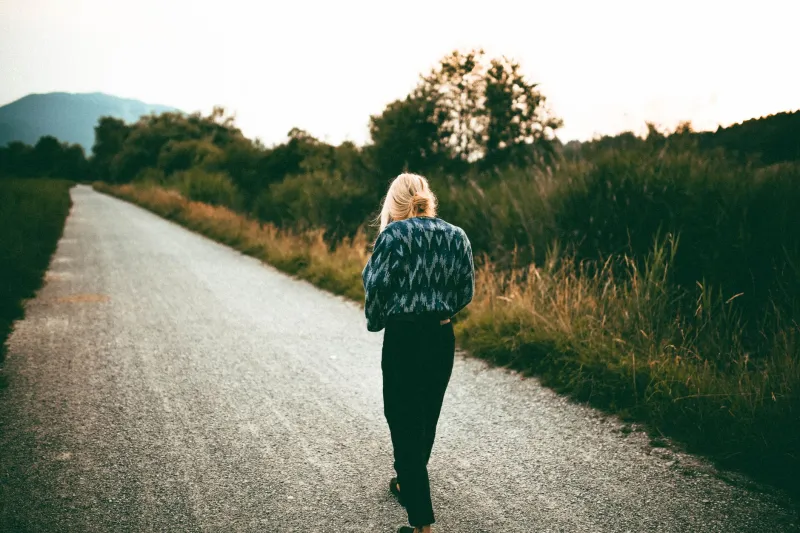
Rooted on Purpose: The Quiet Revolution of Choosing to Stay

For a long time, the story we told ourselves went something like this: the good life is always somewhere else. It's the road trip not yet taken, the city you haven't moved to, the country you're saving up to visit. Motion was the point. Forward was the only direction that counted.
But somewhere between the endless flight deal alerts and the pressure to have a passport full of stamps, something shifted. Quietly, without a big announcement, a lot of people started doing something that felt almost transgressive — they stayed.
When "Going Nowhere" Became the Move
It's easy to dismiss this as pandemic-era residue, a habit born from lockdowns that just never fully unwound. But that reading undersells what's actually happening. People aren't staying put because they can't leave. They're staying because they've started to wonder what they've been missing by always being in motion.
There's a term that floats around certain corners of the internet — "slow living" — but even that framing feels a little too branded, a little too aesthetic-forward. What we're really talking about is something messier and more honest than a curated Instagram feed of linen curtains and sourdough starters. It's the genuine, sometimes uncomfortable experience of actually inhabiting a place instead of just passing through it.
Think about how most of us experience our own cities. We know the restaurant we always go to, the same three routes we drive, the handful of neighborhoods we feel comfortable in. We live in these places for years and somehow still feel like tourists. Choosing to stay — really stay, with intention — is the decision to finally learn the streets you've been ignoring.
The Hustle Culture Hangover
For the better part of a decade, the dominant cultural script in America has been one of relentless optimization. Optimize your mornings. Optimize your career. Optimize your leisure — which, when you think about it, is a deeply strange thing to do. Travel became another metric. How many countries? How many continents? Were you doing it efficiently enough, cheaply enough, Instagrammably enough?
That script is exhausting, and a lot of people are finally admitting it out loud.
The fantasy of constant movement is seductive right up until you're standing in an airport at 5 a.m., sleep-deprived and annoyed, wondering why you thought this was going to feel like freedom. The drift is real — but so is the detail, and the detail requires you to slow down long enough to actually notice it.
There's something worth examining in the way we've romanticized restlessness. It gets coded as ambition, curiosity, open-mindedness. And staying — especially staying in a small town, or in the same apartment for more than two years, or in a city that isn't New York or LA or Austin — gets quietly coded as settling. As lack of imagination. That framing deserves to be challenged.
What You Actually Learn from Staying
Here's the thing nobody tells you: a place reveals itself slowly. The coffee shop that looked unremarkable on your first visit turns out to have the best breakfast sandwich you've ever eaten, but you only know that because you went back six times. The neighborhood that seemed quiet ends up having this whole community of people you'd never have met if you'd been gone every other weekend.
Depth takes time. It's boring to say, but it's true.
When you commit to a place — whether that's your hometown, a city you moved to years ago but never really unpacked yourself into, or even just your own apartment — you start to build a kind of knowledge that travel simply can't give you. You learn the rhythms. The way the light hits your street in October. Which neighbors are actually interesting to talk to. Where to go when you need to feel like yourself again.
That's not nothing. In fact, that might be everything.
Some of the most creatively rich people throughout history were famously rooted. Emily Dickinson barely left her house in Amherst. Wendell Berry has spent his life writing about and farming the same Kentucky land for decades. Their depth of observation came from staying, not despite it. The constraint became generative.
The Permission Slip You Didn't Know You Needed
There's a particular kind of guilt that comes with declining the trip, skipping the weekend getaway, telling people you're just going to be home. It can feel like an admission of something — that you're tired, or broke, or boring. Social media doesn't help. Everyone else seems to always be somewhere spectacular.
But here's a reframe worth sitting with: choosing stillness is a form of self-knowledge. It's knowing what you actually need versus what you think you're supposed to want. And in a culture that profits enormously from your sense of missing out — from your restlessness, your upgrades, your constant consumption of new experiences — opting out of that cycle is quietly radical.
Staying still doesn't mean being passive. It means being present. It means investing in the life you already have instead of perpetually auditioning for a different one.
Learning to Live Where You Are
So what does this actually look like in practice? It's not glamorous, which is kind of the whole point.
It looks like finally exploring the parts of your city you always meant to check out. It looks like getting to know your neighbors beyond a polite wave. It looks like spending a Saturday with no agenda, no destination, just wandering the streets you usually drive past at forty miles an hour.
It looks like letting a place become yours — with all the familiarity and occasional boredom that comes with that. Because boredom, it turns out, is not the enemy. Boredom is often the doorway to something more interesting than another flight to somewhere new.
Drift & Detail is, at its core, about paying attention — to the texture of daily life, to the small things that accumulate into something meaningful. And you can't do that from a plane. You can't do it if you're always halfway out the door.
Sometimes the most interesting place you can be is exactly where you already are. You just have to stop moving long enough to find out.